
Oil Slides As Qatar Touts ‘Talks’ Again; Iran Struck Large Crude Tanker Overnight


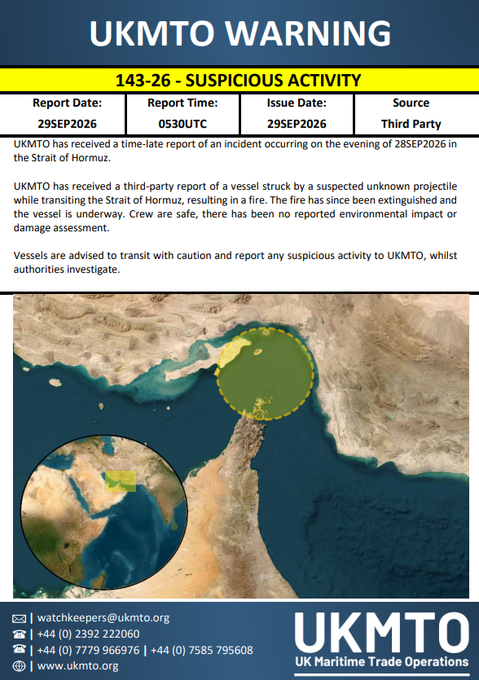
Iran is said to have struck a Very Large Crude Carrier in the Strait of Hormuz late on Monday, signaling what will likely be the resumption of strikes on foreign vessels seeking to navigate the Strait of Hormuz, after last…

Iran is said to have struck a Very Large Crude Carrier in the Strait of Hormuz late on Monday, signaling what will likely be the resumption of strikes on foreign vessels seeking to navigate the Strait of Hormuz, after last week’s diplomatic talks at the UN failed to produce a breakthrough. Still, for the time being more oil is being shipped through the strait compared to where the situation was for the past many months of war.
Maritime monitor UKMTO indicated the vessel was struck by a suspected unknown projectile, resulting in a fire. The fire looks to have been extinguished quickly, with the crew safe and the vessel underway on its transit.
On Tuesday Iran’s parliament speaker Bagher Ghalibaf has reiterated that America should know that “in a region where we don’t sell oil, no one will sell oil.“ He followed with, “If our security is not ensured, no infrastructure will be safe.” Later in the day, Fars reported that another drone has been fired an ‘illicit’ ship, however few details have been given.
Ghalibaf further described during a parliament session that “the era of intimidation and threats is over” and that the Islamic Republic would escalate its responses.
But he also echoed prior words of Iranian President Masoud Pezeshkian, who at last week’s UN General Assembly said that Iran still seeks diplomacy while asserting its rights.
Similar messaging has been newly issued on the Iranian military front, with Major General Yahya Rahim Safavi, who is a senior advisor to the Supreme Leader, saying that the armed forces stand ready to expand the confrontation to new fronts.
Referencing the ongoing Houthi conflict with the Saudis, wherein the Iran-aligned rebel group has captured Yemen’s Red Sea coast, Safavi stated, “The addition of the Bab al-Mandab Strait would change the scene of the war,“ as quoted in IRIB News.
While some reports have long pointed to the likelihood that IRGC advisers assisted the Houthis this month, the high-ranking general suggested Tehran could get more directly involved, or could tell the Houthis to close the Bab al-Mandab Strait to all foreign vessels.
So far, Houthi statements have sought to assure the rest of the world, particularly Europe, that international vessels can still safely pass through, with the exception of Saudi or Israeli-linked ships.
On the question of Strait of Hormuz transit, The Wall Street Journal summarizes the conclusions of several monitoring firms:
Iran’s ability to choke off oil flowing through the Strait of Hormuz—and use that as leverage in talks with the U.S.—is breaking down, raising the risk it will resort to military escalation to bolster its position.
The erosion of Iran’s position comes as the U.S. Navy and Gulf oil producers have become better at fending off or evading Iranian attacks, allowing more tankers to cross the strait.
Middle Eastern crude exports rebounded this month to around their highest level since the war began in February, oil data trackers say. Shipments via Hormuz and bypass routes were delivering just under 80% of their prewar regional flows as of last week, according to tracker Kpler.
Ghalibaf’s aforementioned threat of “no one will sell oil” promises to change this equation – though clearly US Marines are directly involved in trying to protect shipping.
“So far this month, crude exports from major Middle Eastern producers including Saudi Arabia, Iraq, the U.A.E. and others—moving through Hormuz and alternative routes—have risen to almost 13 million barrels a day,” WSJ notes. “That is the highest total since February, when the region exported nearly 19 million barrels a day, according to ship tracker Huax.”
As for talks, Iran has insisted there are no direct talks and that the nuclear file is not up for negotiation, at least until after the war ends with a ceasefire deal in place.
According to a summary of a press briefing by Qatari Foreign Ministry spokesman Majed al-Ansari on Tuesday::
And like clockwork: WTI futures are on session lows, having added to losses after comments from the Qatar Foreign Ministry on possible US-Iran solutions.
Rial at record low against US dollar, with traders in Tehran exchanging more than 2.5 million rials to the dollar.
Source Zerohedge.Com